


Short answer: Restaurants use window film for four jobs that rarely overlap. Solar control film goes on sun facing dining glass to kill afternoon glare and radiant heat so window seats stay usable. UV film protects menus, upholstery, wood, and bottle displays from fading. Frosted or decorative film handles privacy at restrooms, private dining, and booth dividers. Safety film holds a broken storefront pane together over a dining room floor. Most kitchens and dining rooms need two of these, not one film everywhere.
Key takeaways
- The orientation of your glass decides the film, not the size of your windows. A west facing dining room and an east facing coffee shop have opposite problems.
- Film will not slash a restaurant’s power bill. Cooking is 40% of food service energy use and cooling is 7% or less, according to EIA data. What film fixes is the comfort problem at the glass and the load your rooftop unit is already losing to.
- Clear UV film stops roughly 99% of ultraviolet, which is about 40% of what causes fading. It does nothing for the violet and blue light that spoils wine.
- Interior privacy and decorative film can usually go up during normal hours. Exterior solar film on a full storefront is a closed day or an early morning job.
Start with which way the glass faces
This is the part most owners skip, and it’s the part that decides everything else.
Downtown, Main Street runs roughly north to south. So the storefronts on the east side of the street face west and take the full 3 p.m. to sunset load in July. The ones across from them face east and get blasted at breakfast instead. Same street, same block, completely different film spec. A brunch spot with east glass wants glare control without losing the bright morning look people come for. A steakhouse or a bar with west glass wants heat rejection first.
| Glass orientation | What happens | Usual film |
|---|---|---|
| West and southwest | Low sun straight into diners’ eyes from about 4 p.m., worst heat of the day | Higher performance solar control or ceramic film |
| South | Long hours of high angle sun, steady heat load | Solar control film, lighter shade works |
| East | Sharp low glare at breakfast and lunch, minimal heat | Light spectrally selective film |
| North | Little direct sun | Usually nothing, unless you want privacy or safety |
| Patio doors and vestibules | Glare into the room, heat at the transition | Solar film on the glass, exterior shade for the patio itself |
We go deeper on this in our post on choosing film by orientation, and the specification side sits on the commercial window tinting page.
One caveat on patios. Film only helps a patio indirectly, by taming the glass behind it. If the patio itself is uncovered, you need an awning, a pergola, or umbrellas. Film is not a shade structure.
Why the window seats empty out first
Window tables are usually the ones guests ask for. They’re also the first ones people abandon in summer, and the reason is not the thermostat reading.
Two things are happening at that table. Direct sun hitting a person is radiant heat, which they feel regardless of what the air temperature says. And the glare coming off a white tablecloth, a phone screen, or a glass of water forces people to squint at the menu or turn their chair. Neither of those is fixed by turning the AC down two degrees. You just get a cold dining room where the window seats are still miserable.
Solar control film cuts the transmitted solar energy before it reaches the person. Blinds do the same, technically, but blinds have an open position and a closed position, and the closed position throws away the streetscape view you’re paying downtown rent for. That trade off comes up constantly in office work too, and we’ve written about film versus blinds in more detail.
What film actually does to a restaurant’s energy bill
Here’s where I’d push back on a lot of what gets sold to restaurants.
Food service buildings are the most energy intensive commercial building type in the country. The 2018 CBECS survey put them at 263.3 thousand Btu per square foot, against 70 for the average commercial building, even though the average food service building is only about 4,800 square feet. Sounds like a huge savings opportunity. Look at where the energy goes, though.
| End use | Share of food service energy |
|---|---|
| Cooking | 40% |
| Refrigeration | 15% |
| Space heating | 12% |
| Cooling, lighting, ventilation, water heating, other | 7% or less each |
Cooling is a small slice. So anyone promising film will cut your utility bill by a third is selling you something. What film does is narrower and still worth doing: it removes solar load from the one part of the building that has the least equipment fighting for it.
Restaurants have a second wrinkle. Your kitchen hoods are exhausting a lot of conditioned air, and that air gets replaced by outside air. In August, that’s 90 degree makeup air. Your dining room unit is already handling a load it didn’t design for, and then the west wall dumps a few thousand more Btu per hour into the space at 5 p.m. Film takes the second problem off the table. It won’t touch the first. Our post on how commercial tinting affects HVAC costs breaks the math down further.
The other benefit is less obvious. When the west wall stops overloading the system at dinner rush, you stop getting the hot zone near the glass and the cold zone under the diffuser. Even temperatures across a dining room are worth more to a restaurant than a line item on the power bill.
Fading: menus, upholstery, and the bottle display
Fading gets split up roughly like this in the film industry:
| Cause | Share of fading |
|---|---|
| Ultraviolet light | ~40% |
| Visible light | ~25% |
| Heat | ~25% |
| Humidity, pollutants, dye quality | ~10% |
Film handles the ultraviolet portion almost completely. To carry The Skin Cancer Foundation’s Seal of Recommendation, a film has to block at least 99% of UVA and UVB. The UV blocker lives in the adhesive, so a nearly clear film blocks the same UV as a dark one. Shade only affects the visible light and heat shares.
In a restaurant, the things that quietly age are booth vinyl, banquette fabric, wood tabletops that go blotchy on one side, printed menus left in a window rack, and any artwork on a sun facing wall. None of it fails outright. It just makes a five year old dining room look ten.
Now the part almost nobody covers. If you keep a wine display near glass, UV film alone is not enough.
Light damage to wine, called lightstrike, is a photochemical reaction driven by riboflavin. Riboflavin absorbs most strongly at 370 and 442 nanometers, and the damaging band runs roughly 350 to 520 nm. Window film’s UV blocking cuts off around 380 nm. That covers the 370 peak. It passes the 442 peak straight through, because 442 nm is visible violet blue light, not UV. Researchers found riboflavin degraded fastest under cool white LED, which is exactly the light most retail displays use.
So for bottles on display near a window: use a solar film that reduces visible light transmission meaningfully, not just a clear UV film, and keep the good stuff out of the sun line regardless. Clear film is fine for the flooring. It’s not a wine cellar.
Privacy, and glass that breaks over a dining room
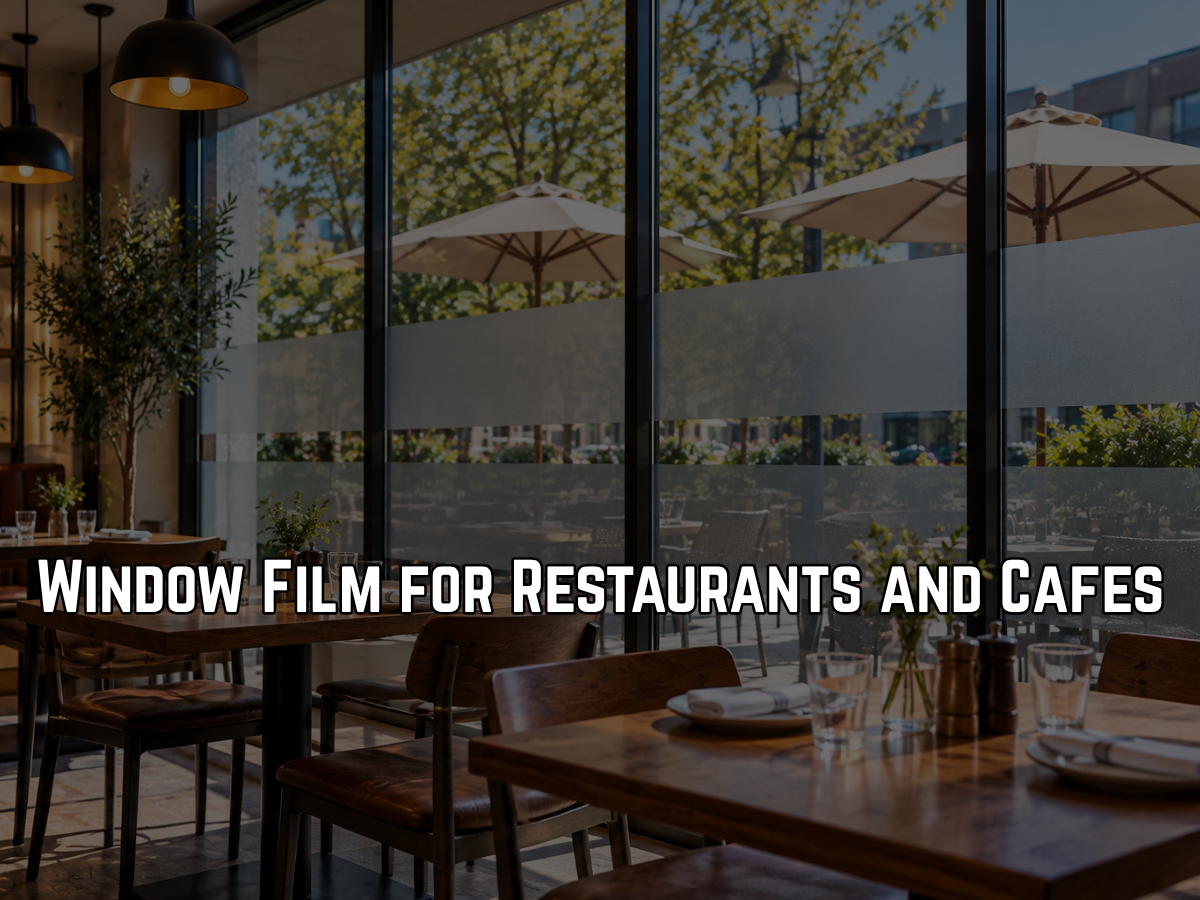
Frosted and decorative film covers the smaller privacy jobs. Restroom windows on an alley. A private dining room off the main floor. Booth dividers where a band of frost at seated eye level gives separation without walling anything in. Etched vinyl with your logo on the entry door does double duty as signage. The frosted versus reflective distinction matters here: mirrored film only works while the outside is brighter than the inside, so after dark it reverses and the room becomes a fishbowl. For a dinner service business, that rules mirrored film out for anything you actually need private.
Safety and security film is a separate product and a separate conversation. It’s a thick polyester layer that holds broken glass in the frame instead of letting it fall. Restaurants have two reasons to care. One is after hours smash and grab on a street level storefront. The other is that your glass sits directly over seated guests, plated food, and open prep. The FDA Food Code’s shatter resistance rule at 6-202.11 applies to light bulbs, not windows, but the reasoning transfers cleanly to a large pane above a service line.
Old glass in Greenville
Two building stocks here need different handling.
The Village of West Greenville and the West End are full of converted textile mill space, and mill buildings came with enormous single pane windows in steel or wood sash. Great light, great character, terrible thermal performance, and a lot of square feet of glass per seat. Film is usually the only realistic fix, since replacing historic sash is expensive and often restricted. Older commercial buildings tend to get more out of film than newer ones for exactly this reason.
The second stock is 1990s and 2000s retail along Woodruff Road, Augusta Road, and Pelham Road, where a lot of restaurants sit in insulated storefront glass. Insulated and low-E units need a film matched to the glazing or you risk thermal stress and a voided glass warranty. Any installer worth hiring asks what the glass is before quoting. On old annealed single pane, the concern is the opposite: absorptive films can raise edge stress in glass that already has flaws in it, which is why an exterior applied film is sometimes the safer call.
Before you schedule
Timing. Interior privacy film on a few pieces of glass is a couple of hours. A full storefront elevation is usually a day. Most restaurants we work with pick a Monday, a closed day, or an early morning before prep starts. Here’s what a commercial install involves.
Your landlord. If you’re in a leased space downtown or in a shopping center, exterior appearance clauses are normal and exterior facing film usually triggers them. Interior frost rarely does. Get approval in writing first. Historic district properties in the West End may have an extra review layer.
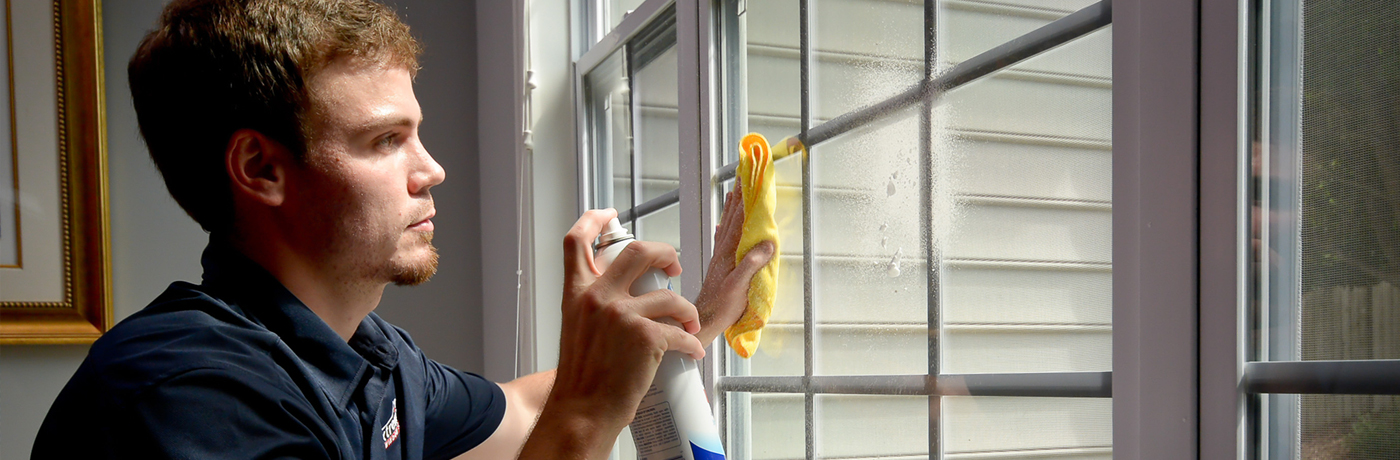
Curing and cleaning. Give the adhesive about 30 days before the first proper clean, then use a soft cloth and a non-ammonia solution. Ammonia and scrub pads haze film over time, which matters in a business where the glass gets wiped daily. Done properly, commercial film runs 10 to 15 years or longer.
Budget. Pricing tracks labor hours and film type rather than a flat rate per square foot, and small panes cost more per square foot than large ones. We’ve laid out the numbers for Greenville separately.
FAQs
Will film make my dining room too dark? Only if you pick a dark film. Modern ceramic and spectrally selective films reject a large share of solar heat while staying fairly light, so light loss is a specification choice rather than something film does automatically.
Can I still put decals and window clings on filmed glass? Yes, but use low tack vinyl and let the film cure first. Aggressive adhesive removal on film is how scratches happen.
Does window film help with a hot kitchen? Rarely. Kitchen heat comes from equipment, not the sun, and most kitchens have little glass to begin with. Spend that money on hood balance and makeup air instead.
Is film worth it for a north facing cafe? For heat and glare, no. For fading protection on a north wall, still sometimes yes, since diffuse UV reaches north glass too. Clear UV film is inexpensive and invisible.
Can film be removed if we redo the space? Yes. Interior film comes off with heat and time and leaves the glass intact. It’s a change you can undo, which is more than most storefront upgrades can say.
