


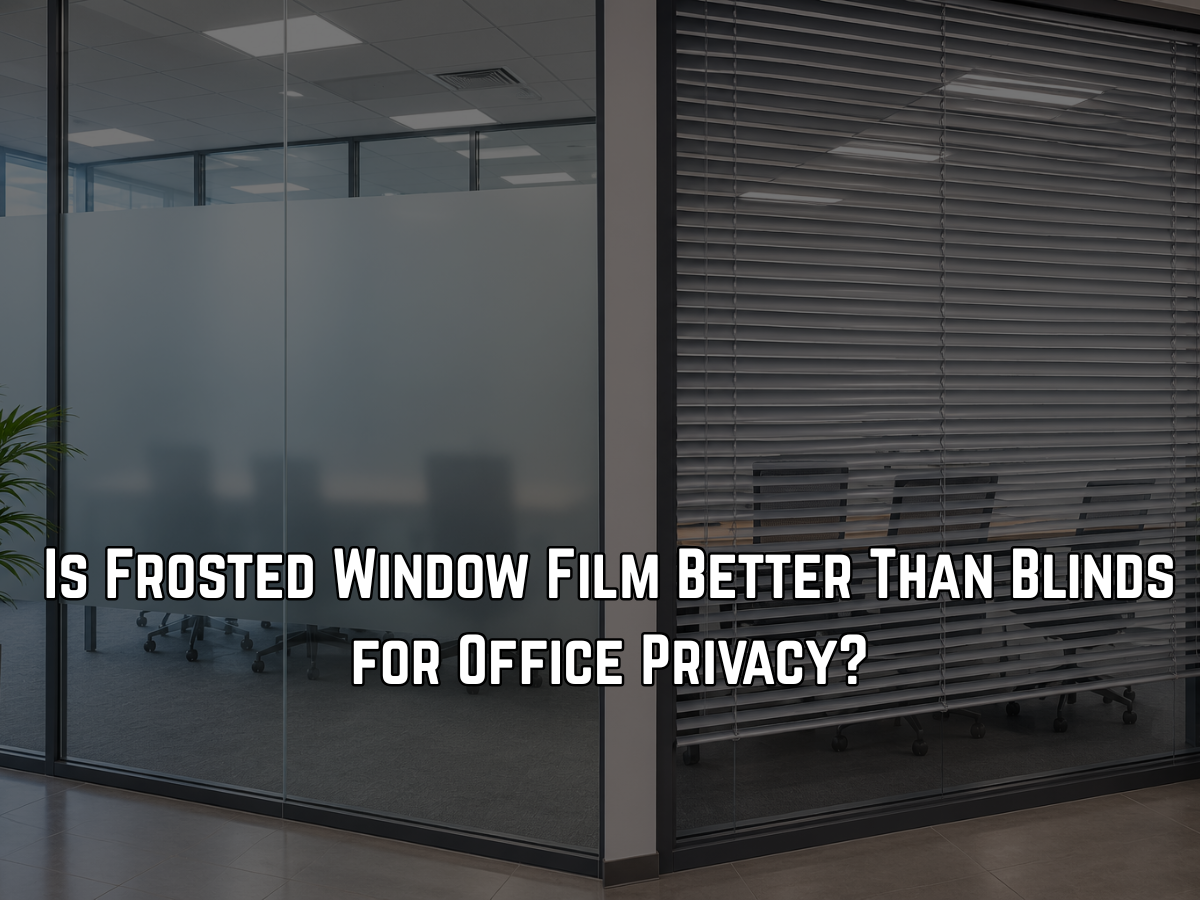
For most offices, yes. Frosted window film gives you steady privacy on glass walls, conference rooms, and street-facing windows without killing the daylight, and it never needs dusting or repair the way blinds do. Blinds still win in one spot: when you need to fully open the view on demand. So the honest answer is “usually film, sometimes blinds,” and which one fits depends on the room.
If you’re weighing privacy options for a whole office, commercial window tinting and blinds solve the same problem in very different ways. Here’s how they actually compare.
Key Takeaways
- Frosted film blocks the view through glass 24/7 while letting roughly 70 to 85% of natural light through. It’s permanent, low-maintenance, and works on interior partitions where blinds can’t go.
- Blinds give you flexible, adjustable control and a clear view when you want one, but they collect dust, break over time, and block daylight when closed for privacy.
- Daylight matters more than people think. In one study, workers with better daylight scored 42% higher on cognitive tasks than those relying on traditional blinds. (source)
- For always-on privacy (glass offices, meeting rooms, storefront glazing), film is the better default. For rooms where you switch between open and private, blinds or a combo make sense.
Quick Comparison: Frosted Film vs Blinds
| Factor | Frosted Window Film | Blinds |
|---|---|---|
| Privacy timing | Constant, day and night | Only when closed |
| Natural light | Keeps most of it (70 to 85%) | Blocks it when shut for privacy |
| Works on glass partitions | Yes | No |
| Maintenance | Wipe clean, no moving parts | Dusting, cord repairs, replacement |
| Lifespan | 10 to 15 years | 3 to 8 years typically |
| Look | Clean, built-in, uniform | Adjustable but bulky |
| Adjustable view | No | Yes |
How Frosted Film Handles Office Privacy
Frosted film works by scattering light through a translucent, etched-glass texture. You can’t make out faces or documents through it, but the glow of daylight still comes through. Think of the privacy you get from a bathroom’s textured glass, applied to office glazing.
The big thing here is that it’s always on. A frosted conference room stays private at 9am and at 9pm, no adjusting, no thinking about it. That’s a real advantage for HR rooms, executive offices, and any space where a private conversation shouldn’t depend on someone remembering to close something.
And it goes where blinds simply can’t. Interior glass walls, sidelights next to doors, and floor-to-ceiling partitions all take film easily. Blinds on an interior glass partition look awkward and defeat the point of having glass at all.
How Blinds Handle Office Privacy
Blinds have one genuine strength: control. Tilt them, raise them, drop them. When you want the window fully open you get the whole view back, which film can’t offer.
But that flexibility comes with strings, sometimes literally. Blinds only give privacy when they’re closed, and closing them means the room goes dim. So you’re often stuck picking between “private” and “bright,” rarely both at once. Anyone who’s worked in a room with the blinds permanently shut against afternoon glare knows the cave-like feeling that follows.
The Daylight Difference (This Is the Real Deciding Factor)
Here’s where the comparison gets interesting, and where I think a lot of offices get it wrong.
When you close blinds for privacy, you throw away the daylight too. That’s not a small thing. Research on office lighting is pretty consistent: people work better and feel better with natural light.
A few numbers worth knowing:
- In a Cornell study, workers in daylit spaces reported a 51% drop in eyestrain, a 63% drop in headaches, and a 56% reduction in drowsiness compared to those in dim, artificially lit areas. (source)
- In a separate survey, 78% of employees said access to natural light and views improved their wellbeing, and 70% reported better work performance. (source)
- The study I mentioned up top found workers with optimized daylight scored 42% higher on higher-order decision-making tasks than the group using traditional blinds. (source)
Frosted film keeps that daylight in the room while still hiding what’s behind the glass. Blinds, when closed, take the light away. For a workspace, that’s a meaningful trade. If daylight and glare balance is a priority, this piece on how window tint affects natural light digs into it further.
Maintenance and Hygiene
This one rarely gets talked about but adds up over the years.
Blinds are dust magnets. Each slat is a flat surface that collects dust, and in an office with a lot of them, cleaning is a recurring chore that mostly doesn’t get done. Cords snap, mechanisms jam, and a busted set of blinds looks shabby fast.
Frosted film is just a smooth surface on the glass. Wipe it with mild soap and water when the glass gets cleaned anyway, and that’s the whole routine. No slats, no cords, no moving parts to fail. Quality film generally lasts 10 to 15 years, while blinds usually need replacing well before that.
Cost Over Time
Blinds can look cheaper upfront, especially the basic vinyl kind. But the math shifts once you factor in a decade of dusting, occasional repairs, and replacement. Film costs more to install but tends to sit there quietly for 10 to 15 years doing its job.
There’s also the productivity angle. If daylight genuinely helps people focus and feel better (and the research says it does), then a privacy solution that keeps the light is doing double duty. That’s harder to put on an invoice, but it’s real.
Aesthetics and Space
Frosted film reads as intentional. It looks like part of the building’s design, gives a clean modern finish, and can carry a logo, gradient, or pattern if you want branding on the glass. It also frees up the sill and adds no bulk, which matters in tight offices or minimalist fit-outs.
Blinds are functional but visually busy, and they take up depth at the window. In a sleek glass-heavy office, they can look like an afterthought bolted onto good architecture.
When Blinds Still Make Sense
Film isn’t the answer everywhere. Blinds are the better call when:
- You genuinely need to open the window fully and often, like a corner office with a view worth showing.
- You want to change the light level through the day rather than keep a fixed look.
- The space is a short-term lease and permanent film isn’t worth it.
In plenty of offices the smart move is both: film on the interior partitions and street-level glass that always need privacy, blinds on the perimeter windows where a flexible view is nice to have. If you’re still deciding between film types before you compare against blinds, our breakdown of frosted vs reflective films for offices is a good next read.
The Bottom Line
For steady, no-fuss office privacy that keeps your space bright, frosted window film beats blinds in most situations. It’s private around the clock, needs almost no upkeep, lasts longer, and holds onto the daylight that helps people work. Blinds keep their place where an adjustable, fully-open view actually matters. Match the tool to the room and you don’t really have to choose one for the whole building.
Offices dealing with glare, heat, or break-in worries on top of privacy might also look at security films for offices, which add impact resistance to the same glass.
