


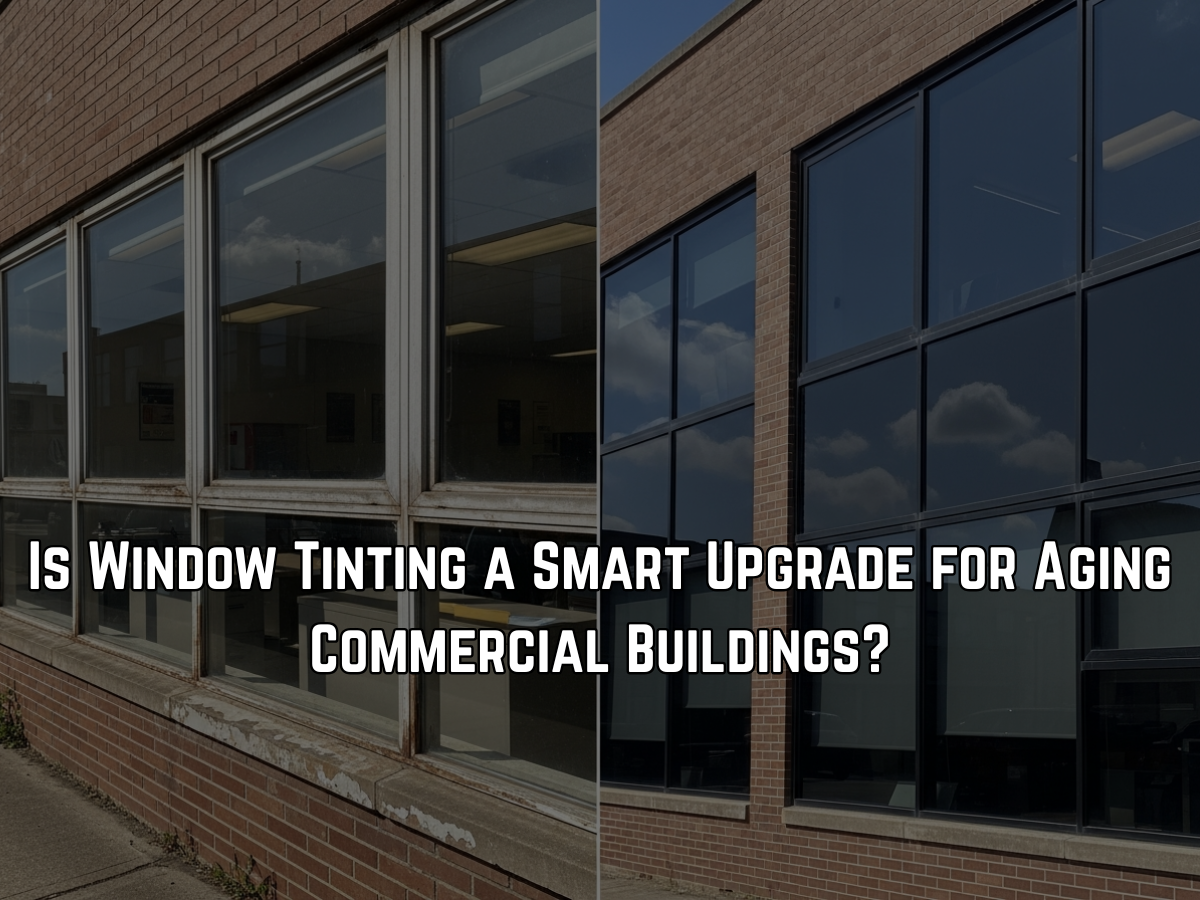
Older commercial buildings carry character. They also carry inefficiencies that drain budgets. Single-pane windows, outdated HVAC systems, and aging materials create ongoing maintenance headaches and escalating energy costs. If you own or manage a commercial property built before 1990, you’re probably facing decisions about which upgrades deliver the best return on investment. Commercial window tinting offers one of the most cost-effective retrofits for aging buildings, addressing multiple problems with a single intervention.
This article examines whether window film makes financial and operational sense for older commercial properties, looking at real-world data rather than marketing promises.
Quick Answer
Window tinting is a smart upgrade for aging commercial buildings because it addresses their most common weaknesses: poor thermal performance, high HVAC costs, and failing building envelopes. Film reduces cooling costs by 15-30%, protects against glass failure, and extends the life of existing windows by 10-15 years without requiring replacement. For buildings with original single-pane windows, film delivers 3-5 year payback periods through energy savings alone.
Key Takeaways
- Buildings constructed before 1990 typically have windows that allow 70-85% solar heat transmission
- Window film reduces solar heat gain by 50-80% without window replacement
- Energy savings average 15-30% on cooling costs in buildings with filmed windows
- Film strengthens aging glass, reducing breakage risk by 60-80%
- Installation causes minimal tenant disruption compared to window replacement
- Older buildings see faster ROI than modern buildings due to greater efficiency gaps
- Film addresses deferred maintenance issues at 15-30% the cost of window replacement
- Single-pane window retrofits show the most dramatic performance improvements
Understanding Aging Building Challenges
Commercial buildings constructed between 1950 and 1990 share common characteristics that create ongoing operational challenges.
Original Window Technology Most older commercial buildings have single-pane or early double-pane windows. These lack the low-E coatings, argon fills, and advanced spacer systems that modern windows use for thermal control. The result? Massive heat gain during summer and heat loss during winter.
A typical single-pane window from the 1970s has a Solar Heat Gain Coefficient (SHGC) of 0.80-0.86. This means 80-86% of solar energy passes straight through. Modern windows achieve SHGC values of 0.25-0.40, blocking most solar heat before it enters the building.
HVAC System Strain Older HVAC systems weren’t oversized enough to handle the massive solar heat gain from inefficient windows. When temperatures hit the high 90s in Greenville, these systems run continuously, struggling to maintain comfortable temperatures while consuming maximum electricity.
The compounding problem? The HVAC equipment itself is aging. A system from the 1980s or 1990s operates at lower efficiency than when new, and it’s fighting an uphill battle against heat pouring through windows. You’re getting the worst of both worlds: inefficient cooling equipment trying to overcome inefficient building envelope.
Deferred Maintenance Accumulation Building owners often delay window replacement because of the cost and disruption. Meanwhile, window performance continues degrading. Seals fail, allowing air infiltration. Glass develops stress cracks. Frames deteriorate. Each year of delay makes the eventual replacement more expensive while current inefficiencies continue costing money.
The Economics of Retrofit vs. Replacement
Let’s address the obvious question: why film instead of replacing windows entirely?
Window Replacement Reality Full window replacement in a commercial building is expensive and disruptive. You’re looking at weeks or months of construction, tenant inconvenience, and significant capital expenditure. For a 20,000 square foot building, window replacement might represent a six-figure investment.
The payback period for window replacement alone typically runs 15-25 years. That’s a long time to wait for ROI, particularly if you’re planning to sell the property within 10 years or if other building systems also need upgrading.
Window Film Economics Film addresses the thermal performance problems of old windows at a fraction of replacement cost. Installation typically takes days rather than months. Tenant disruption is minimal since work happens from inside. And most importantly, the payback period runs 3-7 years depending on current window inefficiency.
For building owners juggling multiple necessary upgrades, film’s superior cost-benefit ratio often makes it the smart choice. You can address windows now at moderate cost while allocating larger budgets to HVAC, roofing, or other critical systems.
Energy Performance Improvements
The energy savings from filming aging windows depend heavily on what you’re starting with. The worse your current windows perform, the more improvement you’ll see.
Single-Pane Window Performance Gains Buildings with original single-pane windows see the most dramatic improvements. Studies by the International Window Film Association (IWFA) show:
- Summer cooling cost reductions: 25-35%
- Peak demand reduction: 20-30%
- Interior temperature stabilization: 8-12 degree reduction in rooms with significant window exposure
- HVAC runtime reduction: 15-25%
These aren’t theoretical numbers. Field studies in commercial buildings across the southeastern United States confirm these ranges. A 1960s office building in Atlanta documented 28% cooling cost reduction after filming all south and west-facing windows with ceramic film.
Early Double-Pane Window Improvements Buildings from the 1980s with early double-pane windows show more modest but still significant gains:
- Summer cooling cost reductions: 15-25%
- Peak demand reduction: 12-18%
- Interior temperature improvements: 5-8 degrees
- HVAC runtime reduction: 10-18%
Even though double-pane windows perform better than single-pane, the absence of low-E coatings means they still allow substantial solar heat gain. Film retrofits these windows to near-modern performance levels.
Quantifying the Savings For a 15,000 square foot commercial building in Greenville with 25% window coverage and electric cooling costs of $3,500 per month during summer (June-September), reducing cooling costs by 25% saves $875 per month or $3,500 annually just during cooling season.
Over a 10-year period, that’s $35,000 in avoided costs. Factor in that energy prices typically increase 2-4% annually, and the total savings grow to $40,000-45,000. Those numbers make the ROI calculation straightforward for most building owners.
HVAC System Benefits
Window film doesn’t just reduce energy costs. It fundamentally changes how your HVAC system operates, often extending equipment life.
Reduced Runtime Equals Longer Life When film blocks 50-70% of solar heat gain, your HVAC system doesn’t need to run as hard or as long. Fewer operating hours means less wear on compressors, fans, and other mechanical components.
HVAC contractors typically estimate that reducing runtime by 20% extends equipment life by 15-25%. For aging systems approaching replacement age anyway, film might buy you 3-5 additional years of service. That’s 3-5 years to budget for replacement rather than facing an emergency repair-or-replace decision.
More Consistent Temperature Control Older buildings often struggle with hot spots near windows. Conference rooms, offices on the building’s sunny side, and corner spaces become uncomfortable during afternoon hours. Employees complain, productivity drops, and you’re constantly adjusting thermostats trying to balance competing needs.
Film eliminates most hot spots by blocking heat at the source. The building maintains more uniform temperatures across all spaces. Your HVAC system can operate at consistent settings rather than constantly ramping up and down trying to compensate for localized heat gain. Understanding various ways to improve office comfort without replacing windows helps address these chronic comfort issues.
Humidity Control Improvements In humid climates like Greenville’s, excess solar heat gain through windows doesn’t just warm the air. It affects humidity control. Your HVAC system must remove both sensible heat (temperature) and latent heat (humidity). When solar heat gain drops, the system can focus more capacity on dehumidification.
Better humidity control means more comfortable spaces and fewer moisture-related problems like mold growth or material degradation. For aging buildings where moisture intrusion might already be a concern, improved HVAC performance helps maintain healthier indoor environments.
Glass Integrity and Safety
Older glass faces increasing failure risk as it ages. Film provides additional structural support that reduces these risks.
Stress Crack Prevention Thermal stress causes many glass failures in aging buildings. Temperature differentials between the center of a glass pane and its edges create stress. Over time, this stress produces cracks that start at edges and propagate across the glass.
Window film helps mitigate thermal stress in two ways. First, by blocking solar heat, it reduces the overall temperature differentials the glass experiences. Second, the film’s adhesive properties help distribute stress more evenly across the glass surface.
Building managers report 60-80% reductions in stress crack incidents after installing film on aging windows. While film can’t prevent all glass failures, it meaningfully reduces a common maintenance headache in older buildings.
Holding Broken Glass Together When glass does fail, either from stress or impact, film holds the pieces together rather than allowing them to fall. This safety feature matters particularly for high-rise buildings or spaces above pedestrian areas.
Insurance companies recognize this benefit. Some provide premium reductions for buildings with filmed windows because of reduced liability from falling glass. For building owners facing rising insurance costs, any legitimate premium reduction helps offset operating expenses. For buildings where safety is paramount, there are specific security films for offices that provide even greater glass retention capabilities.
UV Protection for Interior Materials Aging buildings often house furniture, carpeting, and finishes that have been in place for decades. UV radiation through windows continues degrading these materials, forcing premature replacement.
Window film blocks 99% of UV radiation, dramatically slowing the fading and degradation process. For buildings where capital budgets are tight and replacing interior finishes seems impossible, protecting existing materials extends their useful life by 5-10 years.
Addressing Building Envelope Failures
Older commercial buildings commonly experience building envelope failures that film can help mitigate.
Seal Failure Compensation As window seals age and fail, air infiltration increases. You’re paying to cool or heat air that immediately leaks outside. While film can’t repair failed seals, it does reduce the temperature differential driving air infiltration.
When interior air is 72 degrees and exterior air is 95 degrees, the 23-degree difference creates pressure that forces air through any available gaps. If film keeps that same space at 68 degrees instead of 72 degrees (by preventing heat gain), you’ve reduced the temperature differential to 27 degrees and reduced the pressure driving infiltration.
It’s not a perfect solution. Eventually, failed seals need proper repair. But film buys time while reducing the energy penalty of infiltration.
Frame Degradation Management Metal window frames in older buildings often show thermal bridging problems. The frames conduct heat directly into the building, creating condensation risk and discomfort near windows. Film doesn’t address frame problems directly, but by reducing overall heat load, it minimizes the impact of thermally inefficient frames.
Some building managers use film as a bridge solution. They film windows now to get immediate energy benefits, then plan systematic window replacement over 5-10 years as capital budgets allow. The film provides 70-80% of the energy benefits of full replacement at a fraction of the cost, making the financial equation work while deferring the larger capital expense.
Tenant Comfort and Retention
Older buildings compete for tenants against newer properties with modern amenities. Energy-efficient windows rank high on tenant priority lists. While film doesn’t make old windows new, it addresses the comfort problems tenants actually care about.
Glare Control Large expanses of unfilmed glass create terrible glare on computer screens, particularly in buildings oriented with windows facing south or west. Employees near windows either suffer through the glare or keep blinds closed, defeating the purpose of having windows at all.
Window film reduces glare to manageable levels without requiring closed blinds. Natural light still enters, maintaining the open feeling tenants want, but screen visibility improves and eye strain decreases. For office tenants, this directly impacts productivity and employee satisfaction.
Temperature Consistency Nothing frustrates tenants more than offices that are freezing in winter and boiling in summer despite the building’s HVAC system running at full capacity. Film doesn’t fix all temperature control issues, but it eliminates the single largest variable: uncontrolled solar heat gain through windows.
Tenants notice the difference immediately. Spaces that were previously unusable during certain hours become comfortable all day. Meeting rooms with large windows no longer require cranking the AC to arctic temperatures before afternoon meetings.
Professional Appearance Older buildings sometimes look dated from the outside. Film can actually improve exterior appearance by creating uniform window appearance. Buildings with mismatched curtains, blinds, or nothing at all can look neglected. Uniform film treatment creates a more professional, intentional appearance.
This matters more for buildings trying to attract or retain quality tenants. First impressions count, and improving curb appeal through film costs far less than a complete exterior renovation.
Code Compliance and Energy Efficiency Standards
Aging buildings sometimes face compliance challenges when renovating or changing tenants. Window film can help meet modern energy codes without triggering full building envelope upgrades.
Energy Code Flexibility Some jurisdictions require buildings to meet current energy codes when undergoing substantial renovations or tenant improvements. Replacing windows to meet code costs can derail renovation budgets.
Window film offers a compliance pathway at lower cost. Many energy codes accept window film as an approved method for achieving required Solar Heat Gain Coefficient (SHGC) values. Filming existing windows to reach code-compliant SHGC often costs 20-30% of what full window replacement would run.
This flexibility is particularly valuable for building owners trying to attract new tenants who need extensive interior work. The ability to bring windows into code compliance affordably makes projects financially viable that otherwise wouldn’t pencil out.
Green Building Recognition While filming windows doesn’t earn LEED certification on its own, it contributes to several LEED credit categories: energy performance, indoor environmental quality, and material conservation. For building owners pursuing green building recognition to attract environmentally conscious tenants, film represents low-hanging fruit.
The energy savings documentation from window film helps support broader green building narratives. Tenants increasingly want space in buildings with verified environmental performance. Film provides one component of a comprehensive sustainability story.
Comparison With Other Retrofit Options
Window film isn’t the only retrofit option for improving aging building performance. How does it compare to alternatives?
Film vs. Window Replacement
| Factor | Window Film | Window Replacement |
| Thermal improvement | 60-80% of replacement benefit | 100% (new baseline) |
| Installation timeline | Days | Weeks to months |
| Building disruption | Minimal | Extensive |
| Tenant impact | Work during occupied hours | Often requires space vacation |
| Typical payback | 3-7 years | 15-25 years |
| Additional benefits | UV protection, glare control, safety | Complete window refresh |
For aging buildings where capital is constrained, film delivers most of the thermal benefit at a fraction of the cost and disruption. Window replacement makes more sense when windows are catastrophically failing or when comprehensive building renovation is planned anyway.
Film vs. Exterior Shading Exterior shading devices (awnings, fins, louvers) can effectively block solar heat gain. The challenges are aesthetic approval, structural attachment to aging facades, and maintenance requirements.
Film works from inside, avoiding exterior modification approval processes and structural concerns. For buildings in historic districts or with restrictive design guidelines, film may be the only viable option for improving window performance.
Film vs. Interior Shading Cellular shades, blinds, or curtains provide some solar control. They require occupant compliance (people must close them), block views when deployed, and don’t prevent heat from entering the building, just from reaching the interior.
Film works passively 24/7 without requiring occupant action. It blocks heat before it enters the building envelope, making it fundamentally more effective than interior shading at reducing cooling loads. Beyond energy considerations, tinting office windows has multiple benefits that extend beyond what shading alone can provide.
Installation Considerations for Older Buildings
Filming windows in aging buildings presents some unique considerations compared to newer construction.
Glass Assessment Required Before filming, professional assessment of existing glass condition is critical. Glass with existing stress cracks, chips, or severe seal failure might not be good candidates for film. The assessment identifies which windows can be filmed and which need replacement first.
This pre-installation evaluation prevents problems. Installing film on already-compromised glass can accelerate failure. Professional installers know what to look for and can provide guidance on addressing problem windows before filming.
Access Challenges Older buildings often lack the interior access features of modern construction. Filming windows in buildings with fixed interior architecture or unusual window configurations requires creative approaches and experienced installers.
Understanding what to expect during commercial tint installation helps building managers prepare for the logistics, particularly in buildings where normal work-from-a-ladder approaches won’t work.
Tenant Coordination Film installation happens from inside, meaning installers need access to tenant spaces. For fully occupied buildings, coordinating installation schedules to minimize disruption requires planning.
Most film installations can proceed with tenants in place. Installers work room by room, typically completing each space within a few hours. Unlike window replacement, tenants don’t need to vacate, and normal business operations continue with minimal interruption.
Film Selection for Aging Buildings
Not all window films suit aging building applications equally well. Selection depends on existing window type and building priorities.
For Single-Pane Windows Dual-reflective or high-performance ceramic films make sense. These provide maximum heat rejection (60-70%) to compensate for single-pane windows’ poor baseline performance. The aggressive heat blocking transforms thermal performance from terrible to acceptable.
Visible light transmission can go lower (30-40% VLT) than in modern buildings because you’re making a larger thermal improvement. The slight reduction in natural light is worth the dramatic energy savings and comfort improvement.
For Early Double-Pane Windows Spectrally selective or ceramic films with moderate VLT (45-55%) work well. These provide meaningful heat rejection (50-60%) while maintaining good natural light transmission. You’re improving already-decent baseline performance rather than compensating for terrible performance.
For Large Expanses of Glass Some aging buildings feature curtain wall systems or large window sections. These benefit from film that balances performance with appearance. Dual-reflective films can create exterior mirror effects that some building owners or municipalities don’t like. Non-reflective ceramic films provide excellent performance without exterior appearance concerns.
For Historic Buildings Historic buildings face unique challenges. Many historic preservation guidelines restrict exterior appearance modifications. Interior-applied film generally avoids these restrictions since it doesn’t alter the building’s exterior character.
Clear or very light films preserve the appearance of historic glass while providing UV protection for historic interiors. Some preservation guidelines actually encourage UV film to protect historic interior features from sun damage.
Real-World Case Studies
Numbers matter, but real examples provide context.
1960s Office Building, Greenville A three-story office building with original single-pane aluminum frame windows filmed all south and west exposures with ceramic film. Pre-installation summer cooling costs averaged $4,200 monthly. Post-installation, costs dropped to $3,100 monthly, a 26% reduction. The building documented $4,400 annual savings against installation costs, achieving payback in just over four years.
Beyond energy savings, two long-term tenants who had complained about afternoon heat in their corner offices renewed their leases, citing dramatically improved comfort as a factor in their decision to stay.
1970s Strip Mall Renovation A retail strip center with floor-to-ceiling glass storefronts installed reflective film to reduce both heat and glare. Individual tenants reported 20-35% reductions in cooling costs depending on store orientation and window coverage.
More importantly, the film solved a chronic problem with sun damage to merchandise. Several tenants had experienced significant markdown losses on window display merchandise that faded before it could sell. After filming, merchandise fading became a non-issue, improving inventory turnover and reducing write-offs.
1980s Medical Office Building A medical office complex filmed all windows with spectrally selective film that maintained natural light while reducing heat and blocking UV. The building had aging HVAC equipment scheduled for replacement within 2-3 years.
After filming, HVAC runtime dropped enough that the building extended equipment life by an additional 4 years before replacement. The deferred HVAC capital expense provided cash flow to address other needed building improvements. When HVAC replacement eventually happened, the reduced thermal load allowed installing smaller, less expensive units than originally specified.
Strategic Implementation Approaches
For large or complex buildings, phased implementation makes sense.
Priority-Based Phasing Film the worst-performing spaces first. South and west-facing windows in occupied spaces deliver the most immediate tenant satisfaction. First-phase improvements generate positive feedback that builds support for additional phases.
This approach also provides data. Document energy consumption and tenant feedback from filmed spaces. Use that information to project benefits for subsequent phases and secure budget approval.
Tenant Turnover Integration Some building owners time filming to coincide with tenant turnover. Between tenants, installers have unrestricted access to spaces. The film is in place when new tenants arrive, becoming part of the improved space they’re leasing.
This approach extends implementation timelines but eliminates tenant coordination challenges and demonstrates building improvements to prospective tenants during tours.
Capital Budget Alignment For buildings with annual capital improvement budgets, filming can be integrated into planned improvement cycles. Year one might address the worst-performing facade, year two another facade, until the entire building is filmed over 2-4 years.
This budgeting approach makes the expense manageable while still delivering cumulative benefits as each phase completes.
Making the Decision
Is window film a smart upgrade for your aging commercial building? The answer depends on several factors.
Film Makes Sense When:
- Original single-pane or early double-pane windows are still in place
- Energy costs are high relative to comparable buildings
- Tenants complain about temperature or glare issues
- Capital budget doesn’t support full window replacement
- The building will remain in service for at least 10 more years
- HVAC systems are aging and reducing their load extends useful life
Film May Not Be Optimal When:
- Windows are already failing and need replacement regardless
- Building is scheduled for demolition or complete renovation within 3-5 years
- Windows already have low-E coatings and perform reasonably well
- Building has minimal window coverage where impact would be small
For most aging commercial buildings in Greenville with significant window coverage and original or early-retrofit windows, film delivers compelling ROI. The combination of energy savings, comfort improvements, and deferred maintenance makes it one of the more cost-effective building upgrades available.
The key is approaching film as part of a comprehensive building performance strategy, not as a silver bullet. Film addresses thermal performance and UV issues brilliantly. It doesn’t fix failing HVAC systems, poor insulation, or other building envelope problems. But it does deliver measurable improvements at reasonable cost, buying time and providing cash flow benefits that support addressing other building needs.
For building owners juggling limited capital budgets and competing maintenance demands, window film represents a rare opportunity: an upgrade that pays for itself through operational savings while simultaneously improving tenant satisfaction and building value. That combination makes it worth serious consideration for nearly any aging commercial building with significant window exposure.
