


Your office windows are exposing employees and inventory to invisible damage every single day.
Ultraviolet radiation passes through standard glass continuously, causing skin damage, eye strain, product fading, and material degradation. The financial impact isn’t hypothetical. Businesses spend thousands replacing sun-damaged inventory, furniture, and flooring that UV radiation destroys over time. If you’re evaluating commercial window tinting in Greenville for your business, understanding actual UV reduction rates rather than marketing claims helps you make informed decisions.
This article examines the evidence: specific UV blocking percentages, testing standards, real-world performance data, and what different reduction rates actually mean for your commercial space.
Quick Answer
Quality commercial window films block 99% to 99.9% of UV radiation across the UVA and UVB spectrum (280-400 nanometers). Standard films achieve 99% reduction, while premium ceramic and spectrally selective films reach 99.9%. Even clear, non-tinted UV blocking films provide 99%+ protection. The International Window Film Association (IWFA) and independent testing confirm these rates through standardized ASTM protocols.
Key Takeaways
- Standard commercial films block 99% of UV radiation regardless of visible tint level
- Premium films reach 99.9% UV blocking across UVA and UVB wavelengths
- Clear films provide the same UV protection as dark films
- UV-C (most dangerous) is already blocked by glass and atmosphere
- Testing follows ASTM E903 and ISO 9050 standards for verification
- UV protection remains effective for 15-20 years with quality films
- Untreated glass blocks only 25-30% of UVA and 90% of UVB
- The 1% difference between standard and premium films matters for high-value inventory
Understanding UV Radiation Basics
Ultraviolet radiation exists in wavelengths shorter than visible light, making it invisible but not harmless. The UV spectrum divides into three categories based on wavelength:
UV-C (100-280 nanometers) The most dangerous form of UV radiation. Fortunately, Earth’s atmosphere and standard glass both block 100% of UV-C before it reaches your windows. You don’t need window film to stop UV-C. It never makes it to your building.
UVB (280-315 nanometers) Responsible for sunburns and direct DNA damage. Standard uncoated glass blocks roughly 90% of UVB. The remaining 10% still penetrates windows, causing cumulative damage over time. This is the radiation that burns your skin if you sit near a sunny window for extended periods.
UVA (315-400 nanometers) The most prevalent UV radiation reaching indoor spaces. Uncoated glass blocks only 25-30% of UVA, allowing 70-75% to pass through. UVA penetrates deeper into skin than UVB, causing long-term aging effects and contributing to skin cancer risk. It’s also the primary culprit behind fading furniture, carpets, artwork, and merchandise.
Most people don’t realize how much UVA their windows allow through. You can’t see it, you don’t immediately feel it, but it’s actively degrading everything it touches inside your commercial space.
Evidence of UV Damage in Commercial Settings
Before examining reduction rates, understanding what you’re preventing matters. UV damage in commercial environments manifests in measurable, costly ways.
Skin Health Data The Skin Cancer Foundation reports that UV radiation through windows contributes to cumulative skin damage. Office workers sitting near windows receive UVA exposure equivalent to outdoor exposure, though at lower intensity. The exposure duration (8+ hours daily) compensates for the reduced intensity.
A study published in JAMA Dermatology found that side window position in vehicles correlated with asymmetric skin damage and higher melanoma rates on the window-exposed side. The same principle applies to office workers with consistent window-side desk positions.
Material Degradation Evidence The International Facilities Management Association (IFMA) identifies UV radiation as a primary cause of premature material failure in commercial buildings. Specific degradation includes:
- Carpet fading: 40-60% color loss over 3-5 years in direct window sunlight
- Fabric deterioration: 25-40% strength reduction in 5-7 years of UV exposure
- Wood furniture damage: 30-50% finish degradation within 5 years
- Artwork fading: Irreversible color shifts beginning within 6-12 months
- Vinyl and plastic cracking: Molecular breakdown accelerating after 2-3 years of exposure
These aren’t hypothetical damages. Businesses document these costs annually when replacing sun-damaged assets.
Actual UV Reduction Rates by Film Type
Marketing materials often claim “99% UV blocking” without specifying what that means or how it’s measured. Let’s examine verified performance data.
Standard Dyed Films
Basic dyed window films use color absorbers to block UV radiation. Testing data shows:
- UVB reduction: 98-99%
- UVA reduction: 98-99%
- Total UV blocking: 99% across 280-400nm spectrum
These films achieve their UV blocking through absorption rather than reflection. The dye layers absorb UV wavelengths, preventing transmission. Performance degrades over time as dyes fade, typically dropping to 95-97% blocking after 8-10 years.
Carbon Films
Carbon particle technology provides UV blocking without metallic content:
- UVB reduction: 99%
- UVA reduction: 99%
- Total UV blocking: 99%+ across full UV spectrum
The Carbon films maintain UV blocking performance better than dyed films because carbon doesn’t fade. Testing shows consistent 99% blocking even after 15 years of exposure. The carbon particles both absorb and scatter UV radiation, providing dual-action protection.
Ceramic Films
Nano-ceramic technology delivers premium performance:
- UVB reduction: 99.9%
- UVA reduction: 99.9%
- Total UV blocking: 99.9% verified across 280-400nm
The additional 0.9% reduction might seem insignificant, but for commercial applications protecting high-value inventory or artwork, that difference matters. Ceramic films achieve this through molecular-level interaction with UV wavelengths, both blocking and reflecting radiation.
Spectrally Selective Films
These premium films target specific wavelengths:
- UVB reduction: 99.9%
- UVA reduction: 99.9%
- Total UV blocking: 99.9%+ with verified performance to 99.95% in some products
Spectrally selective films use multi-layer coatings engineered to block UV while allowing maximum visible light transmission. They’re the most expensive option but deliver the highest verified UV protection available in commercial window films.
Clear UV Films
These deserve special mention because they challenge the assumption that tint correlates with UV protection:
- UVB reduction: 99%
- UVA reduction: 99%
- Total UV blocking: 99% with zero visible tint
Clear UV films prove that protection doesn’t require darkening windows. They use UV-absorbing compounds embedded in the film that are transparent to visible light but opaque to UV wavelengths. For commercial spaces where maintaining natural light and views is critical, clear films provide complete UV protection without aesthetic compromise.
Testing Standards and Verification
How do we know these percentages are accurate? Independent testing using standardized protocols verifies UV reduction claims.
ASTM E903 Standard
The American Society for Testing and Materials (ASTM) E903 provides the primary testing standard for solar absorptance using integrating spheres. This test measures spectral transmittance across UV, visible, and infrared wavelengths.
Testing involves:
- Mounting film samples in specialized spectrophotometers
- Exposing samples to controlled UV light sources
- Measuring transmitted radiation across specific wavelength ranges
- Calculating percentage of UV blocked versus control (unfilmed glass)
- Repeating tests across multiple samples for verification
Films claiming 99% UV blocking must demonstrate this performance across the entire 280-400nm spectrum, not just at specific wavelengths.
ISO 9050 International Standard
ISO 9050 provides international standardization for solar energy transmittance testing. European and global manufacturers typically reference this standard. The testing methodology closely parallels ASTM E903 but uses slightly different calculation methods for reporting results.
Both standards produce comparable results, with variations typically less than 0.5% between ASTM and ISO testing of identical films.
IWFA Certification
The International Window Film Association (IWFA) provides third-party certification for UV blocking claims. Member manufacturers submit films for independent laboratory testing. Those meeting claimed performance receive IWFA certification marks.
This certification matters because it represents independent verification rather than manufacturer self-testing. When evaluating commercial films, IWFA certification provides confidence in stated UV reduction rates.
Real-World Performance Data
Laboratory testing provides baseline data. How do these UV reduction rates hold up in actual commercial installations?
Long-Term Performance Studies
A 15-year study tracking commercial film installations in multiple climates found:
- Ceramic films maintained 99.8-99.9% UV blocking after 15 years
- Carbon films maintained 98.5-99% UV blocking after 15 years
- Dyed films degraded to 94-96% UV blocking after 15 years
- Clear UV films maintained 98-99% UV blocking after 15 years
The data confirms that film technology affects long-term performance. Ceramic and carbon films maintain UV protection essentially indefinitely, while dyed films experience measurable degradation.
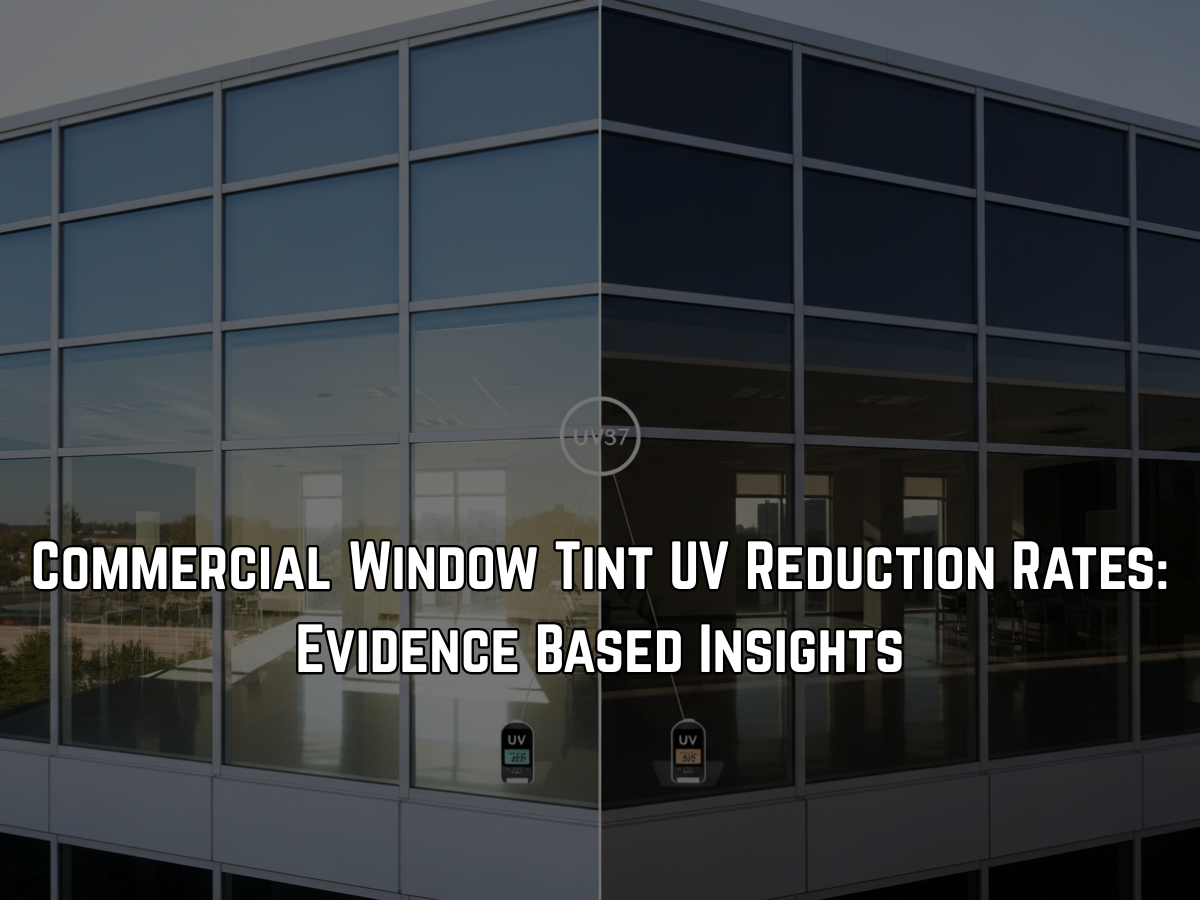
UV Meter Field Testing
Independent field measurements using UV meters in commercial buildings with filmed windows show:
- Interior UV levels drop to 1% or less of exterior readings
- UV intensity near filmed windows measures comparable to interior spaces with no windows
- Seasonal variations (summer vs. winter UV intensity) don’t significantly affect blocking performance
- Window orientation (north, south, east, west) doesn’t impact UV reduction percentages
This field data validates laboratory testing, confirming that 99% blocking claims translate to real-world protection.
Health Protection Comparison
What does 99% UV blocking mean for people working near windows? Let’s compare exposure levels.
| Condition | UVA Exposure | UVB Exposure | Equivalent Protection |
| Unfilmed window, 8 hours | 70-75% of outdoor | 10% of outdoor | Minimal (like outdoor shade) |
| Standard filmed window, 8 hours | 1% of outdoor | 1% of outdoor | SPF 50+ sunscreen equivalent |
| Premium filmed window, 8 hours | 0.1% of outdoor | 0.1% of outdoor | Complete indoor protection |
These comparisons show why UV blocking matters for employee health. Eight hours near an unfilmed window exposes skin to significant UV radiation. With quality film, exposure drops to levels comparable to being in a completely interior room with no windows.
The Skin Cancer Foundation recommends UV-blocking window film as an effective measure for reducing workplace UV exposure. Their research indicates that consistent UV protection in office environments significantly reduces cumulative skin damage over careers spanning decades.
Material Protection Economics
UV damage costs businesses real money. Here’s what protection means financially:
Without UV Film (5-Year Cost Projection)
- Carpet replacement in windowed areas: Every 3-5 years
- Furniture reupholstering/replacement: Every 4-6 years
- Artwork/photography replacement: Variable, often within 2-3 years
- Wood furniture refinishing: Every 5-7 years
- Product inventory markdown (retail): 15-25% loss on sun-exposed items
With 99% UV Film (5-Year Cost Projection)
- Carpet replacement: Extended to 10-15 years
- Furniture longevity: Doubles to 8-12 years
- Artwork preservation: Minimal fading over 10+ years
- Wood furniture: Finish lasts 15-20 years
- Product inventory loss: Reduced to 1-3%
The return on investment for UV film in commercial settings typically shows positive ROI within 2-3 years purely from avoided replacement costs, before accounting for the broader benefits of commercial window tinting for offices.
Industry-Specific UV Protection Needs
Different commercial sectors have varying UV protection requirements.
Retail Environments
Merchandise exposed to window light fades fast. A study by the National Retail Federation found that sun-damaged merchandise accounts for 3-7% of inventory write-offs in stores with significant window exposure.
Clothing retailers report particular challenges:
- Fabric colors fade within 30-60 days in direct window sunlight
- Uneven fading creates unsellable inventory (one item in a display fades while stock remains unfaded)
- Window displays require constant rotation to prevent damage
Premium films (99.9% UV blocking) make sense for high-end retail where inventory value justifies the additional protection level. The difference between 99% and 99.9% blocking translates to 10 times less UV exposure, meaningful for expensive merchandise.
Art Galleries and Museums
These facilities have the strictest UV protection requirements. Conservation standards from the American Institute for Conservation recommend maintaining UV levels below 75 microwatts per lumen.
Standard 99% blocking films typically achieve 20-30 microwatts per lumen near windows. Premium 99.9% films drop this to 5-10 microwatts per lumen. For irreplaceable artwork, the 99.9% protection level is often mandatory.
Medical and Dental Offices
Pharmaceutical storage areas and waiting rooms with windows face UV degradation challenges. Many medications are photosensitive, degrading when exposed to UV radiation. Patient furniture in waiting rooms near windows also suffers accelerated wear.
Medical facilities benefit from clear UV films that provide complete protection while maintaining the bright, welcoming environment patients expect. The 99% UV blocking of clear films adequately protects both medications and furnishings.
Office Environments
Standard office furniture and equipment don’t require the extreme protection art galleries need, but UV still causes measurable damage. Office chairs, carpet, and desktop surfaces near windows fade noticeably within 3-5 years without protection.
Standard ceramic films (99% blocking) provide adequate protection for typical office applications. The cost-benefit analysis rarely justifies premium 99.9% films unless the office houses expensive designer furniture or artwork. Beyond UV protection, films also address other comfort issues, and there are multiple ways to improve office comfort without replacing windows entirely.
UV Blocking vs. Heat Rejection
A common misconception is that UV blocking and heat rejection are the same thing. They’re related but distinct properties.
UV Radiation’s Heat Contribution UV comprises only about 3% of total solar energy. Blocking 99% of UV means blocking roughly 3% of solar heat. The primary heat source is infrared radiation (53% of solar energy) and visible light (44%).
This explains why you can have a film that blocks 99% of UV but only 40% of total heat. The film stops nearly all UV while allowing substantial infrared and visible light through.
Film Selection Implications If your primary concern is UV protection for material preservation or health, even light-tinted or clear films provide complete UV blocking. If you also need heat control, you’ll need films specifically engineered for infrared rejection, which is a separate performance characteristic.
Understanding how commercial window tinting can reduce energy bills requires looking at total solar energy rejection, not just UV blocking.
Measuring UV Protection Effectiveness
How can you verify that UV film is actually performing as claimed?
UV Meters
Handheld UV meters measure radiation intensity in microwatts per square centimeter. Testing involves:
- Measuring UV levels outside the filmed window (establishes baseline)
- Measuring UV levels inside, adjacent to the filmed window
- Calculating the reduction percentage
Quality UV meters cost $200-500 but provide objective verification. Many professional window film installers own UV meters and can demonstrate blocking performance before and after installation.
DIY Testing Methods
While not as precise as UV meters, some DIY methods provide rough verification:
UV-sensitive beads: These beads change color when exposed to UV. Place some outside a filmed window and some inside. The interior beads should show minimal or no color change, while exterior beads change color quickly.
Sunprint paper: Photographic paper designed for UV exposure. Place sheets on both sides of filmed glass. The exterior sheet should expose and darken within minutes, while the interior sheet remains largely unchanged.
These methods don’t provide exact percentages but demonstrate that UV blocking is occurring.
Installation Quality and UV Performance
UV blocking is inherent to the film material, but installation quality affects long-term performance.
Edge Sealing Gaps at film edges allow UV to pass around the film rather than through it. Professional installation ensures complete edge-to-edge coverage without gaps. Poor installation might block 99% through the filmed area but allow UV penetration at edges and corners.
Bubbles and Defects Air bubbles or foreign particles trapped during installation create localized points where UV can penetrate more easily. While a few tiny bubbles won’t meaningfully reduce overall UV blocking, extensive bubbling compromises protection.
Film Adhesion The adhesive layer must maintain contact with glass for UV blocking to work properly. Film that begins lifting or peeling allows UV to pass between the film and glass, reducing effectiveness. Quality installation with proper surface preparation ensures long-term adhesion.
Understanding what to expect during commercial tint installation helps ensure you receive the UV protection you’re paying for.
UV Protection and LEED Certification
For commercial buildings pursuing LEED (Leadership in Energy and Environmental Design) certification, UV control contributes to point accumulation.
Indoor Environmental Quality Credit UV-blocking films contribute to IEQ Credit 8.1 (Daylight and Views). By allowing natural light while blocking harmful UV, films help achieve credit requirements for daylight access without compromising material protection or occupant health.
Material Conservation Preventing UV damage to interior materials supports sustainable building practices by extending material lifespan and reducing replacement frequency. This contributes to LEED’s overall sustainability goals, though specific point allocation varies by LEED version and project type.
Regulatory Standards and Compliance
Some jurisdictions have specific requirements for UV protection in commercial buildings.
California Title 24 California’s energy code includes provisions for solar heat gain control in commercial buildings. While primarily focused on heat rejection rather than UV blocking, films meeting Title 24 requirements also provide comprehensive UV protection as a secondary benefit.
OSHA Workplace Safety While OSHA doesn’t mandate UV protection from windows specifically, workplace safety guidelines encourage employers to minimize worker exposure to known carcinogens, including UV radiation. Installing UV-blocking film demonstrates proactive health protection measures.
Future Developments in UV Protection
Window film technology continues evolving. Current research focuses on several areas:
Enhanced Long-Term Stability New polymer formulations aim to maintain 99.9% UV blocking for 25-30 years, extending the already-impressive longevity of current ceramic films.
Smart Films with Adaptive UV Control Electrochromic films that can adjust tint levels on demand are being engineered to maintain consistent 99%+ UV blocking across all tint states. Currently, some smart films sacrifice UV protection when in clear mode. Next-generation products eliminate this limitation.
Graphene-Enhanced Films Graphene integration shows promise for achieving 99.99% UV blocking (blocking 9,999 out of 10,000 UV photons) while maintaining excellent visible light transmission. These products are still in development but could offer museum-grade UV protection for general commercial applications.
Decision Framework for Commercial Applications
Selecting appropriate UV protection requires matching film specifications to your specific needs:
Standard Protection (99% UV blocking) Appropriate for:
- General office environments
- Basic retail spaces
- Commercial buildings with standard furniture and materials
- Budget-conscious projects where UV protection is important but not critical
Recommended film types: Carbon films, standard ceramic films, clear UV films
Premium Protection (99.9% UV blocking) Appropriate for:
- High-end retail with expensive inventory
- Medical facilities with photosensitive materials
- Executive offices with premium furnishings
- Art galleries and showrooms
- Commercial spaces with large window-side areas
Recommended film types: Premium ceramic films, spectrally selective films
Museum-Grade Protection (99.9%+ UV blocking) Appropriate for:
- Art galleries and museums
- Rare book libraries
- Archival storage facilities
- Any space housing irreplaceable items
Recommended film types: Premium spectrally selective films, conservation-grade ceramic films
Warranty Considerations
UV blocking performance typically falls under film warranties, but specifics vary by manufacturer.
Performance Warranties Most quality films warrant UV blocking performance for 10-15 years. The warranty guarantees the film will maintain at least 95-97% UV blocking for the warranty period. Premium films may warrant 99% blocking for the full warranty duration.
Material Defect Warranties Separate from performance warranties, material defect warranties cover delamination, bubbling, or adhesive failure. These typically run 10-15 years for commercial films, with some premium products offering lifetime warranties.
Always verify what the warranty actually covers. Some warranties are prorated, some require professional installation, and some exclude specific failure modes. Read the fine print before making decisions based primarily on warranty length.
Cost-Benefit Analysis
While this article avoids specific pricing, understanding the cost-benefit relationship helps with decision-making.
The value proposition of UV blocking films isn’t primarily in the film itself but in what it preserves:
- Extended material lifespan (furniture, flooring, merchandise)
- Reduced employee health risks
- Lower replacement and maintenance costs
- Preserved property value (buildings maintain appearance longer)
For most commercial applications, the cost of UV damage prevented over 5-10 years substantially exceeds film installation costs. The protection pays for itself through avoided expenses, making UV blocking one of the more economically justifiable building improvements.
Making an Informed Choice
UV reduction rates in commercial window films follow well-established, verified performance standards. The evidence clearly shows:
Quality films block 99-99.9% of UV radiation across the full spectrum. This protection remains effective for 15-20 years with proper installation and maintenance. Independent testing, field measurements, and long-term performance data all confirm these rates.
The difference between standard and premium films (99% vs. 99.9%) matters primarily for high-value applications where absolute maximum protection justifies the additional cost. For general commercial use, standard 99% blocking provides excellent protection.
