


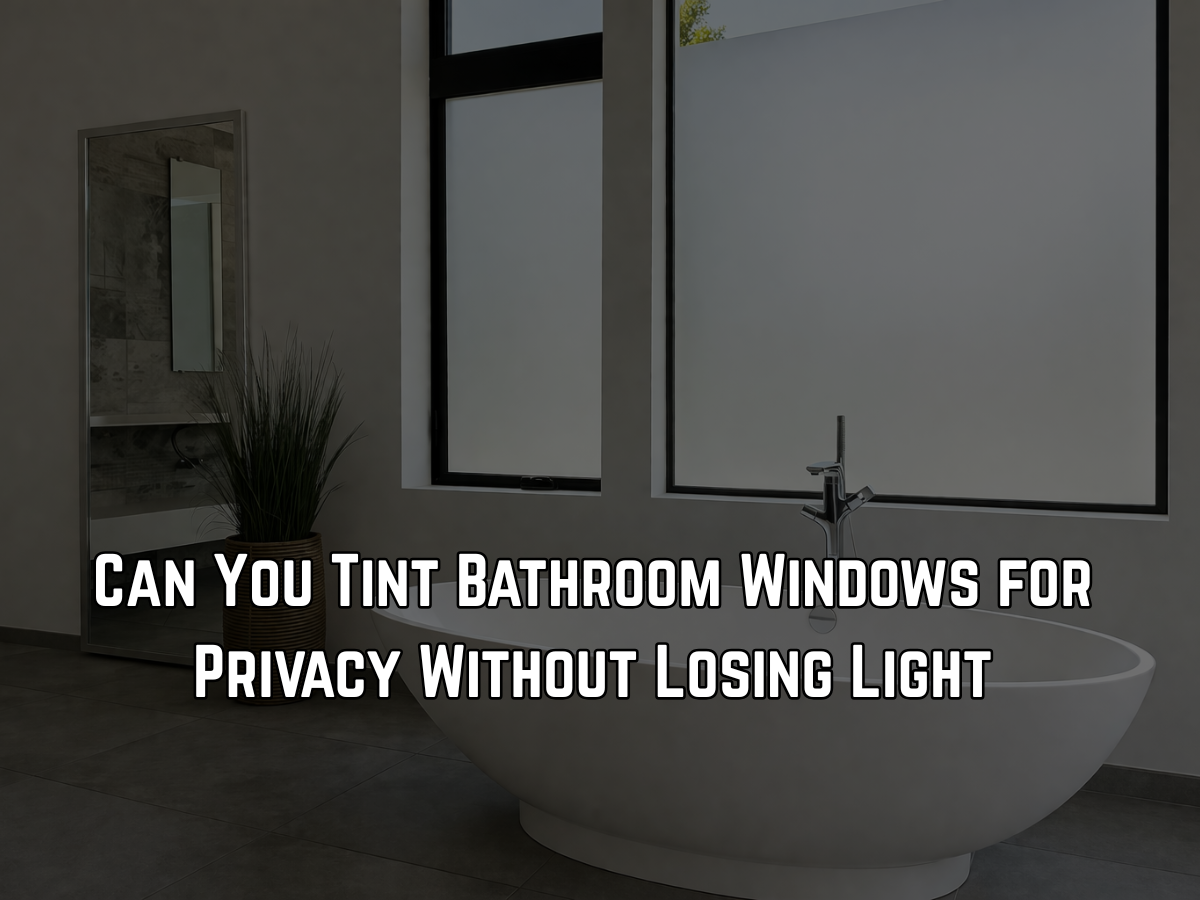
Short answer: Yes, and it’s probably the easiest privacy upgrade you can make in a bathroom. The trick is picking a film that diffuses light instead of blocking it. Tint bathroom window films, especially frosted and decorative options, can keep your space private around the clock while still letting in 30% to 90% of natural daylight, depending on the opacity you choose.
Key Takeaways
- Frosted films give 24/7 privacy because they scatter light instead of relying on reflection. Reflective films only work in daytime.
- Light frost films can transmit up to 90% of visible light, while heavy frost sits around 30% VLT for full bathroom-grade privacy.
- Bathrooms are humid, but quality adhesive films are moisture-resistant and won’t peel, mildew, or trap steam when properly installed.
- Decorative and gradient films let you keep partial views (top half clear, bottom half private) so the room never feels closed off.
- Curtains and blinds in a bathroom collect dust, mold, and steam damage. Film doesn’t.
Why Bathroom Windows Are a Privacy Problem in the First Place
Bathrooms are usually small, ground-level rooms with at least one window facing a side yard, a neighbor’s wall, or an alley. Clear glass works fine for the kitchen. In a bathroom, it’s a problem the moment you turn the lights on after dark.
Most homeowners try the obvious fixes first: blinds, curtains, maybe spray-on frosting from the hardware store. They all have issues. Blinds collect grime and warp from steam. Fabric curtains absorb moisture and start to smell. Aerosol frosting peels in patches within a year. None of these were really designed for a humid room with daily temperature swings.
Window film was. It bonds to the glass itself, so it can’t trap moisture between layers, and it doesn’t care how steamy your shower gets. If you’re upgrading a bathroom anyway, this is one of the few privacy fixes that pays back every single day without ever needing maintenance.
Privacy Films That Don’t Sacrifice Light
There’s no single “bathroom film.” There are about four categories that work, and the right one depends on whether you want total opacity, some view, or a decorative element. Here’s the breakdown.
Frosted Films (the standard pick)
Frosted film mimics the look of sandblasted or etched glass. It’s translucent, not transparent. Light passes through, shapes don’t. From outside, you’ll see a soft glow at night and what looks like obscured glass during the day. From inside, the bathroom stays bright.
| Frost Level | VLT (Light Through) | Privacy | Best For |
| Light Frost | ~90% | Moderate | Upper-floor bathrooms, low risk of being seen |
| Medium Frost | ~60% | High | Most standard bathrooms |
| Heavy Frost | ~30% | Total (24/7) | Ground-floor bathrooms, shower windows, neighbor-facing glass |
The numbers above come from Contra Vision’s frosted film range, where Light Frost transmits 90% VLT with a 3/5 privacy rating, Medium Frost sits at 60% VLT with 4/5 privacy, and Heavy Frost provides 30% VLT with full 5/5 two-way privacy day and night. Most homes end up somewhere in the medium-to-heavy range for bathrooms.
A point worth knowing: frosted window film provides approximately 95% visual privacy while still letting good light through, because the translucent surface diffuses light and creates a blur that makes it nearly impossible to make out clear details from outside. So even at higher VLT, you’re not really visible.
Decorative and Patterned Films
These are frosted films with patterns: linen textures, geometric shapes, stained-glass looks, gradients. Functionally they behave like frosted film but they look more intentional. If your bathroom has a clean modern design or you want the window to look like a feature instead of a fix, decorative is the way.
A small note from a real install: pattern density matters. A light geometric pattern on clear film looks great but barely adds privacy. Look for decorative films that specify their VLT and opacity, not just their pattern.
Gradient Films
A gradient film transitions from opaque at the bottom to clear at the top (or vice versa). They’re a smart pick for bathrooms with a window that’s tall enough to give you sky views above eye level. You get privacy where you need it and full daylight where you don’t. Common in master bathrooms with garden tubs near the window.
Reflective (One-Way Mirror) Films
These work, but with one big caveat: they only provide privacy when it’s brighter outside than inside. During daylight hours, frosted film performs excellently from outside looking in, but at night with interior lights on, the privacy effect can diminish by approximately 15 to 20% depending on the film quality. For reflective films, the effect basically reverses at night.
If you only use the bathroom during the day, a reflective film is fine. Most people don’t. So for bathrooms, frosted or decorative is the safer bet for round-the-clock privacy. We’ve actually compared these two head-to-head in frosted vs reflective films for offices, and the same principle applies in a residential setting.
How Much Light Will You Actually Lose?
This is the question everyone asks, and the answer depends on the VLT you pick. Here’s a rough sense of what each opacity feels like in real use:
- 70% to 90% VLT (light frost): You’ll barely notice. Light is slightly diffused. Good for bathrooms that are already bright.
- 40% to 60% VLT (medium frost): A clear softening of the light. The room feels calm rather than dim. Most people land here.
- 20% to 40% VLT (heavy frost / opaque): Noticeably darker. Fine if you have good vanity lighting and don’t rely on the window as your main light source.
For context, we’ve written more about how window film affects natural light across different VLTs and rooms.
In a bathroom specifically, the lighting math is a little different than the rest of the house. You probably have overhead lights, vanity lights, and maybe a shower fixture. Even with a heavy frost film cutting daylight to 30%, the room won’t feel dark when those are on. The natural light is mostly there for ambiance and for making the space feel less cramped.
What About Humidity, Steam, and Cleaning?
A fair concern. Bathrooms are humid. Some films, particularly cheap static-cling kits, can lose grip in steamy conditions over time. But proper architectural-grade adhesive films are built for it.
According to Campbell Window Film, window film is extremely durable and will not deteriorate due to humidity, mold, or mildew, and it can be cleaned the same way as regular glass. Quality films don’t peel in humidity, don’t grow mildew, and don’t need any special care.
A few practical notes from installs we’ve done in Greenville bathrooms:
- Adhesive films outperform static cling. Static cling is fine for renters or temporary fixes. For a long-term install in a humid room, go adhesive.
- Wait 24 to 48 hours before showering. New film needs time to fully bond. Hot steam right after install can cause edge lifting.
- Clean with mild glass cleaner and a soft cloth. Skip ammonia and abrasive pads. They’ll cloud the film over time. Same care rules apply as in our guide to cleaning residential window tint.
If your bathroom window is also a shower window (rare but it happens), make sure the installer uses a film rated for direct moisture contact, not just humid air. There’s a real difference.
Choosing Based on Your Bathroom Type
Not every bathroom has the same situation. A guest powder room with a tiny street-facing window has different needs than a master bath with a big garden window. Here’s a rough guide.
| Bathroom Type | Recommended Film | Why |
| Ground-floor or street-facing | Heavy frost (30% VLT) or decorative opaque | Total 24/7 privacy is the priority |
| Upper-floor with neighbors close by | Medium frost (60% VLT) | Privacy without darkening the space |
| Master bath with tall windows | Gradient film | Privacy at eye level, sky views above |
| Powder room (no shower) | Decorative patterned film | Aesthetic upgrade plus privacy |
| Bathroom with strong sun exposure | Frosted ceramic blend | Privacy plus heat and UV control |
That last one is worth expanding on. Some bathrooms, especially west-facing ones, get brutal afternoon sun. A standard frosted film handles privacy but doesn’t do much for heat. A ceramic-based privacy film can handle both, blocking heat and UV while diffusing light. We get into the differences between film types in ceramic vs carbon vs dyed films if you want the technical side.
For homes with multiple bathrooms or a more whole-home approach, think of bathroom film as one piece of a broader residential window tinting plan. Different rooms call for different VLTs, and getting them right makes the whole house more comfortable.
Common Mistakes to Avoid
Bathroom film is a small project, but a few easy missteps can ruin the result:
- Picking pretty over functional. A delicate floral pattern on clear film looks lovely on Pinterest. It also lets people see right through. Always check VLT and opacity, not just the design.
- Choosing reflective for a north-facing bathroom. Reflective film needs sunlight to work. If your bathroom window faces a shaded yard or a neighbor’s wall, the reflective effect won’t kick in. Frosted is more reliable here.
- Going too dark. Some homeowners pick blackout film thinking they need maximum privacy. They end up with a bathroom that feels like a closet. Heavy frost gives near-total privacy without going opaque.
- DIY on a textured or pebbled glass window. Film needs flat, smooth glass to bond properly. Existing textured glass will leave gaps and cause peeling. Replace the glass first, or use film designed for textured surfaces (rare and tricky).
- Skipping the install for a $20 kit. Static cling kits exist and can work for a quick fix. But if you want a film that lasts 10+ years and doesn’t bubble in your shower’s humidity, professional install is worth it.
When Window Film Isn’t the Right Call
I’ll be upfront here: window film isn’t always the answer.
If your bathroom window is broken, single-pane, or has visible seal failure, replacing it is the better call. Tinting a bad window doesn’t fix the underlying problem. Same goes if you actually want a clear view (like a high-mounted bathroom window facing trees), where blinds you can open and close make more sense.
For most other situations though, especially if you’re sick of dusty blinds or moldy curtains, film is the lower-maintenance, longer-lasting option.
The Bottom Line
You can absolutely tint bathroom windows for privacy without losing light. The catch is choosing the right film. Skip reflective for a bathroom unless you don’t use it at night. Stick with frosted, decorative, or gradient films, and match the VLT to how much light you actually want. Heavy frost for ground-floor windows, medium for most cases, light frost or gradient when you want to keep the room feeling open.
Done right, the result is a bathroom that’s brighter than it was with blinds, more private than it was with sheer curtains, and easier to maintain than either. That’s a pretty good trade.
If you’re not sure which opacity fits your specific window, having a sample held up to your actual glass usually settles it in about 30 seconds. The right film should feel like an upgrade, not a compromise.
